
Book Appointment Now

Absent Periods – Amenorrhea
What is Amenorrhea?
Did you just missed your another period and started wondering if something wrong or not ? First of all, you are not alone. Almost 20% women globally experience missed periods at some point in their life. It is mostly treatable, so nothing to worry too much.
Amenorrhea simply means the absence of menstrual periods. It may occur if the girl has not started menstruating by the expected age around 11 to 12 years, or if a woman who was menstruating previously, suddenly stops getting them for three months or 90 days.
Missing a period doesn’t always mean you are pregnant. Stress, Oily fast food habit, Obesity, Excessive workout, Hormonal Balance, PCOD/PMOS, certain medications and some medical conditions can affect your menstrual cycle.
Your menstrual cycle is often a reflection of your overall health. When periods stop unexpectedly, it’s actually your body telling you to put some attention. The good news is that most women with Amenorrhea can be diagnosed with proper investigations and treatment is quite successful.
Here we will help you understand why periods stop, when you should see a doctor, what tests may be needed and treatment options available, so you can take you next step more confidently.
Normal Menstrual Cycle
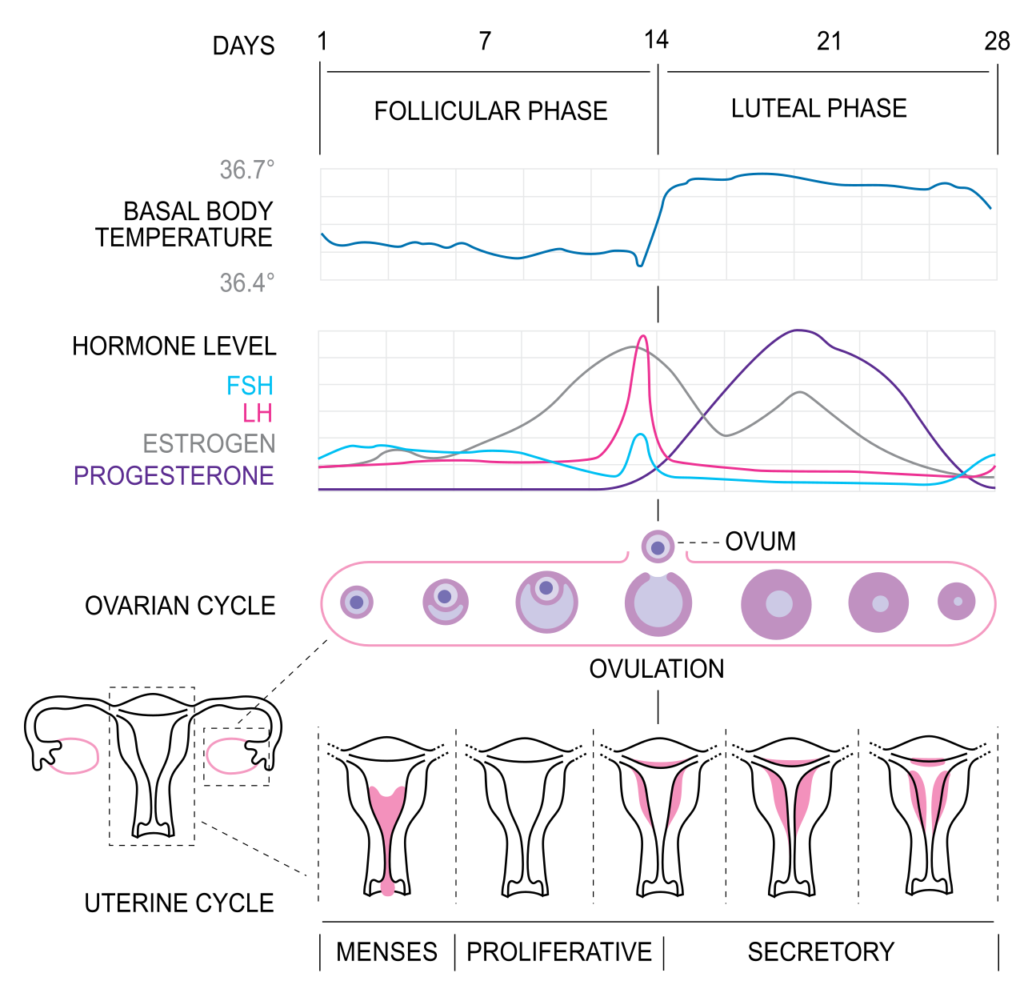
Think of your menstrual cycle as your body’s monthly way to prepare you for pregnancy. Every month you body goes through multiple changes in hormone levels. If pregnancy doesn’t happen the lining inside uterus is shed along with spiral blood vessels, known as Menstruation, commonly called period.
FSH, LH and Estrogen, Progesterone – the four hormones responsible for all these things happening in your body. Think of them as four team members working together every month. The brain starts the process by releasing Gonadotropin Releasing Hormones, which tell the ovary to prepare an egg. FSH helps the egg to grow inside the ovary. As the egg grows, it produces Estrogen which thickens the lining of uterus so it becomes ready for pregnancy.
Around the middle of the cycle, a sudden rise in LH causes the ovary to release a mature egg. This is called Ovulation. After ovulation the empty follicles become Corpus Leuteum, which produces the progesterone. Progesterone keeps the uterine line healthy and support the pregnancy. If pregnancy doesn’t occur, the level of Progesterone and Estrogen will fall. Estrogen acts like Bricks & Progesterone acts like cement. When the level falls, the uterine lining breaks down and starts menstruating.
A normal menstrual cycle is counted from the first day of your menstrual cycle. For most of the woman the cycle varies from 21 days to 35 days, although 28 days cycle is taken as an example in medical field. The bleeding usually last for 2-7 days. It is important to note that every female’s body is different.As the period ends, your body starts preparing for the next cycle, an egg begins to mature and all those things.
Understanding menstrual cycle increases the chance to recognise when something is off. If your periods stop unexpectedly, become irregular or missed multiple, its a good time to consult your doctors.
Type of Amenorrhea
Amenorrhea is broadly divided into two types:
- Primary Amenorrhea
- Secondary Amenorrhea
Primary Amenorrhea
Primary amenorrhea means a girl who never got menstruation and no Breast Bud at the age of 13 years. Or Female who never got periods but developed Breast Bud by the age of 15 years. Doctors usually starts investigating the kid at the age of 15 yrs, irrespective of breast bud development.
Primary Amenorrhea may occur because the ovaries are not fully functional, or the uterus or vagina didn’t develop properly, or may be the brain not sending any signal to ovaries. The most common cause of primary amenorrhea is Gonadal Dysgenesis.
Secondary amenorrhea
Secondary amenorrhea means, a lady who was menstruating normally, got stoppage of periods for 3 months or 90 consecutive days.
The most common reason is Pregnancy. This is always the first possibilities come to our minds. Other common causes include breast feeding, pcos, thyroid disorders.
Although missing one period occasionally is not always a cause of concern, missing several periods without any clear reason should never be ignored. Identifying the underlying cause is the key to treatment.
Causes of Amenorrhea
- Pregnancy
- Breastfeeding
- Menopause
- Thyroid disorders
- Excess exercise
- Eating disorders
- Obesity
- Stress
- Premature ovarian insufficiency
- Vaginal septum
- Medications
- Hyperprolactinemia
- Asherman Syndrome
- Kallmann Syndrome
- Craniopharyngioma
- Swyer Syndrome
- Turner syndrome
- Mullerian agenesis
- Androgen insensitivity syndrome
- Sheehan syndrome
Symptoms
- No menstrual period
- Headache
- Acne and only skin
- Excess facial or body hair
- Weight gain
- Vaginal dryness
- Fatigue
- Pelvic pain
When should you see a doctor?
- You missed period for 3 months or more and are not pregnant.
- You are 15 years older and have never had your first period.
- Your period stopped suddenly after being regular.
- You have severe recurrent pelvic pain, repeated lower abdominal pain.
- You think, you might be pregnant.
- You developed facial hair, severe acne, weight gain.
- You experience hot flashes, vaginal dryness, or other symptoms of early menopause.
Diagnosis
To find the cause of amenorrhea, your doctor will begin by asking you simple questions on your menstrual history, medical conditions, medications, weight changes, exercise habits, and sexual activity. This followed by a physical examination. Depending on your age, symptoms, your doctor may recommend one or two of the following tests.
- Pregnancy Test – The first and most important test for woman sexually active and within reproductive age group.
- Blood test – Blood tests like FSH, LH, Prolactin, Thyroid Hormones, Estrogen & sometimes Testosterone.
- Pelvic ultrasound – To examine the uterus and ovaries and look for conditions such as PCOS or Structural Abnormalities.
- MRI Scan – If a pituitary gland problem is suspected, especially when prolactin is high or headache or vision less.
- Your doctor may recommend Genetic Testing, Hysteroscopy, or other specialised investigations to find other suspected causes.
Treatment
The main treatment of Amenorrhea depends on it’s underlying cause. Once the reason is identified, your doctor will recommend the most appropriate treatment.
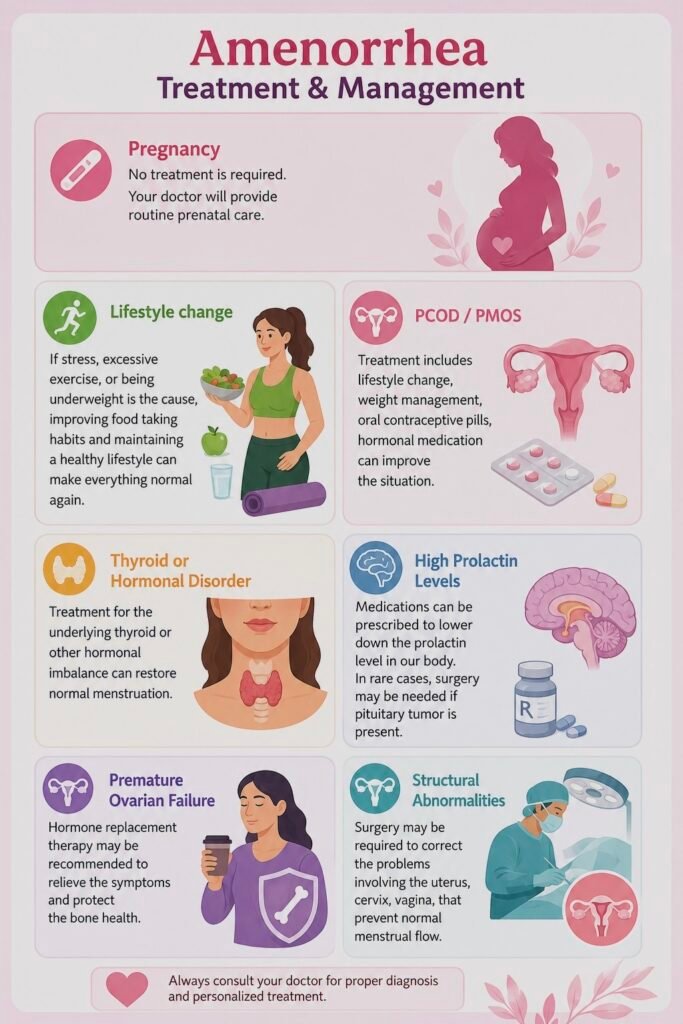
Pregnancy
No treatment is required.your doctor will provide routine prenatal care.
Lifestyle change
If stress, excessive exercise, or being underweight is the cause, improving food taking habits and maintaining a healthy lifestyle can make everything normal again.
Pcod / pmos
Treatment includes lifestyle change, weight management, oral contraceptive pills, hormonal medication can improve the situation
Thyroid or hormonal disorder
Treatment for the underlying thyroid or other Hormonal imbalance can restore normal menstruation.
High prolactin levels
Medications can be prescribed to lower down the prolactin level in our body. In rare cases, surgery may be needed if pituitary tumor is present.
Premature ovarian failure
Hormone replacement therapy may be recommended to relieve the symptoms and protect the bone health.
Structural abnormalities
Surgery may be required to correct the problems involving the uterus, cervix, vagina, that prevent normal menstrual flow.
Possible complications
If the underlying cause of amenorrhea is not treated, it can lead to severe health problems, including:
Difficulty getting pregnant
Women who are not ovulating repetitively, may face problems in future for conceiving.
Weak bones
Low estrogen level over time can reduce bone strength and increase the risk of fractures.
Pregnancy complications
Some conditions causing amenorrhea may increase the risk of complications if pregnancy occurs.
Heart and blood vessels
Long term estrogen estrogen deficiency may increase the risk of cardiovascular disease.
Emotional disease
Anxiety, stress, depression, and reduced self confidence can occur due to uncertainty or fertility concerns.
Sexual problems
Vaginal dryness and pain during intercourse may occur, especially if estrogen levels are low.
Progression of the underlying condition
Untreated disorders, such as PCOS, thyroid disease, pituitary disorders, or premature ovarian insufficiency can lead to additional health problem.
Can Amenorrhea be prevented?
Not all cases of amenorrhea can be prevented. However you can reduce the risk by –
- Maintaining a healthy body weight.
- Eating a balanced, nutrition diet.
- Exercise regularly, but not doing excessive exercise.
- Managing stress through healthy coping strategies.
- Attend regular health checkup and seeking medical advice if your period becomes irregular or stop unexpectedly.
Read More : https://my.clevelandclinic.org/health/diseases/3924-amenorrhea