
Book Appointment Now

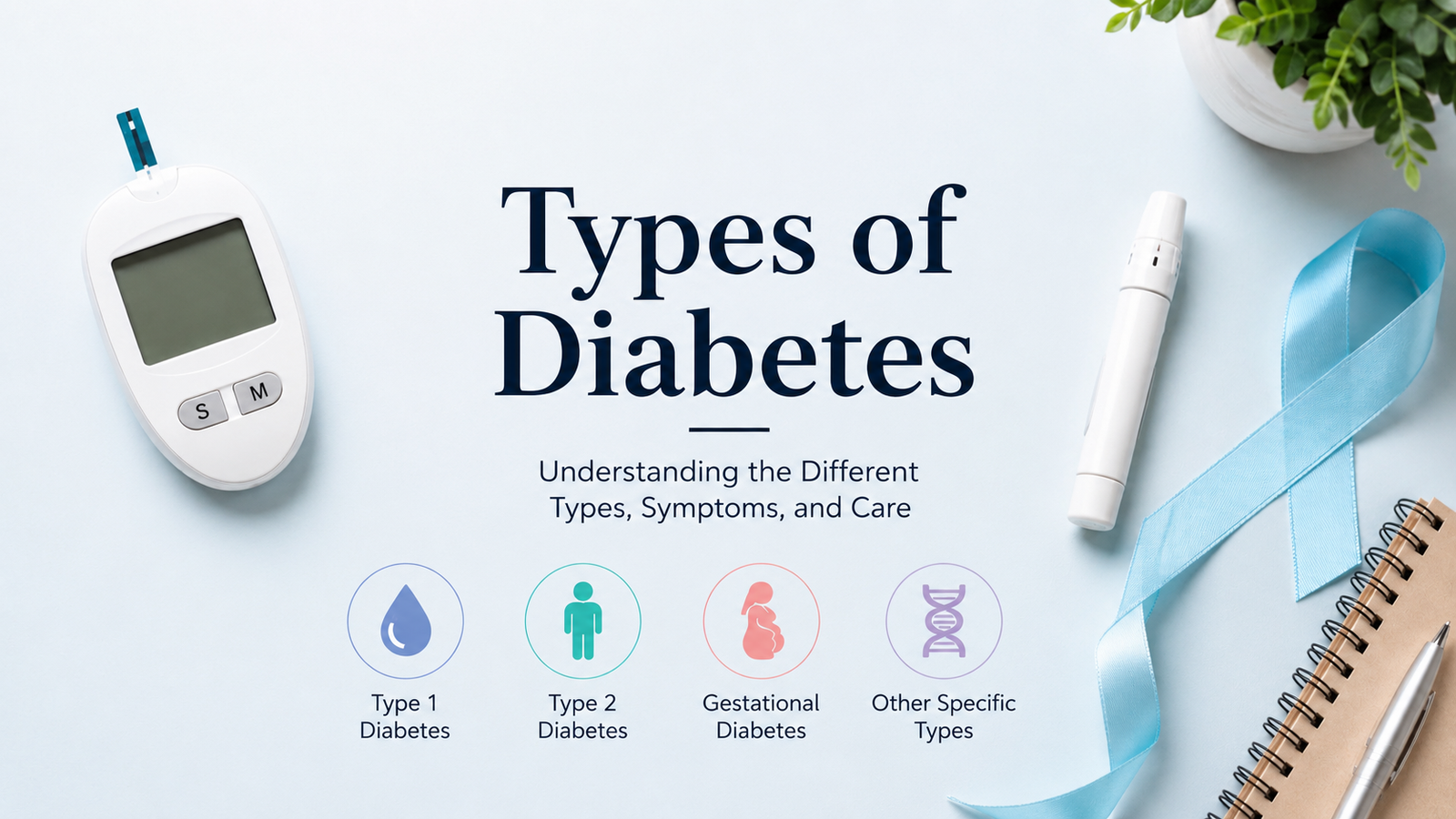
Types of Diabetes – All 7 types of Diabetes
Introduction
Diabetes mellitus is one of the most common chronic disease in the world affecting hundreds of millions of people and contributing to serious complications involving the heart, kidney, eye, nerve, and the blood vessels. While many people think that the Diabetes is simply Type 1 or Type 2, but the reality is far more complex.
Over the years, our understanding of Diabetes has evolved significantly. In addition to the well-known research Type 1 and Type 2 Diabetes, researchers and clinician now recognised multiple several other types of Diabetes. In this article, we will explore the major types of Diabetes, their causes, clinical features, diagnostic clue and how they differ from one another in understanding. These discussion is essential because accurate classification can influence treatment, decisions, prognosis, and long-term outcome for the patient.
Types
We mainly know, there are two kinds of Diabetes- Type1 and Type2. But for doctors there are 4 more types of Diabetes. So there are total 6 types of Diabetes
- Type 1
- Type 2
- Type 1.5
- Type 3
- Type 4
- MODY
Type 1.5 Diabetes further divided into two parts.
- KPD
- LADA
So today we will discuss all these types Diabetes to have a clear idea about them.
Type 1 Diabetes Mellitus
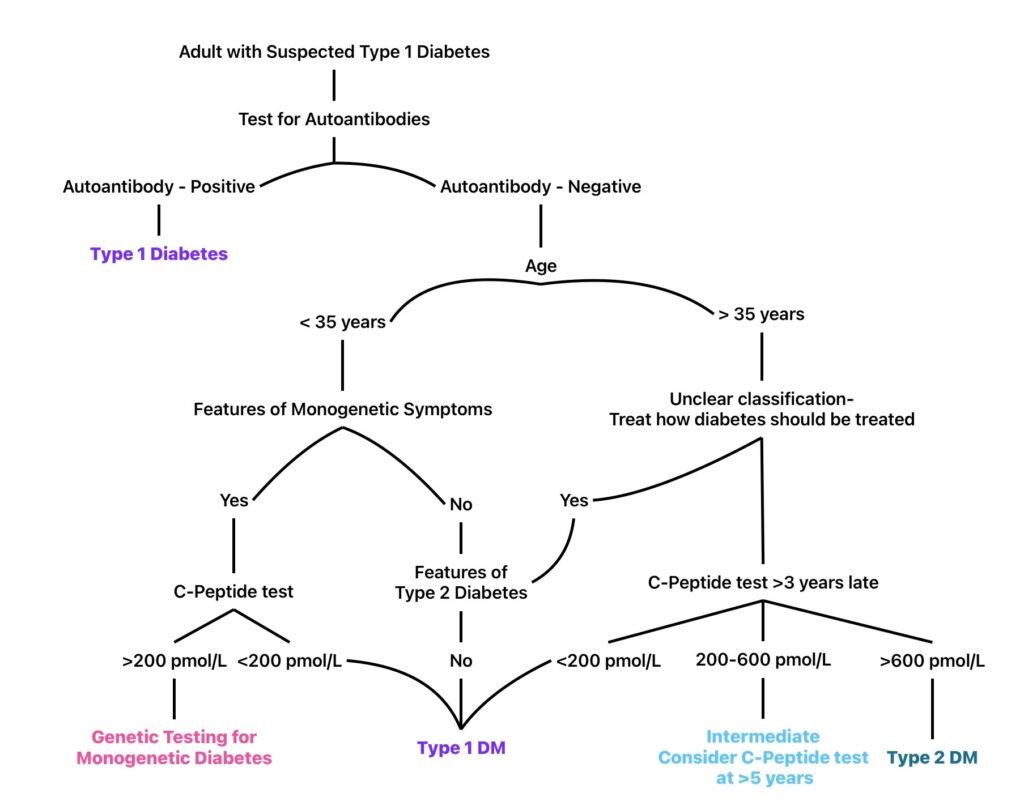
T1 DM is mainly an autoimmune disorder, defect in Chromosome 6.Here the destruction of beta cells happen. Beta cell of the pancreas produces Insulin, which maintain the blood glucose level within normal limits. But when these beta cells are destroyed, insulin can not be produced and the blood glucose level is increased.
Type 1 diabetes is mainly seen among the young adults any children. Why? Because when these beta cells are not functioning properly and blood sugar spike happens, the symptoms appears acutely.symptoms start appearing from neonatal time and diagnosed earlier. But in Type 2 diabetes, there is constant high blood sugar level and no proper symptoms appears, thus diagnosed many years later from its onset.
The patients in Type 1 Diabetes are mainly thin people because the cells of their body can not uptake Glucose effectively, so the body thinks it’s starving. As a result body starts to burn fat for energy, resulting loss of fat, weight loss and produces ketone body.
On the other hand, body also breaks down protein to glucose through Gluconeogenesis. This leads to Muscle wasting, Reduced body weight and weakness.
Though it’s mainly seen among the children, it sometimes found in adults also. Around 80% destruction of pancreatic beta cells produces type 1 diabetes. The time to happen this 80% destruction varies from person to person, so may occur at any age, but predominantly found among the children. There is a term called Honeymoon Phase, which is around 3 years. The phase describe the time interval between the initial presentation (After 80% destruction) and next presentation,which happens due to 100% destruction of the beta cells of pancreas. Patients don’t show any symptoms in during this phase. The main reason for this to happen if the treatment is not continued properly.
Diagnosis
1. Blood Glucose level
| Fasting Blood Sugar | >126 mg/dl |
| Random Blood Sugar | >200 mg/dl |
| 2 hour OGTT | >200 mg/dl |
| HbA1c | >6.5% |
2. Antibody Testing
- Anti-GAD (Glutamic acid decarboxylase)
- Anti ZnT8
- Anti insulin antibody
3. Low level C-Peptide indicates little or no insulin production from pancreas
Type 2 Diabetes Mellitus
In Type 2 diabetes mellitus, there is a presence of functional insulin, but the tissue present in our body cannot take up those Insulin. So resulting in lack of glucose inside the cell. Type 2 diabetes mellitus is diagnosed years later from its onset. The continuous high level of glucose hides the symptom from appearing, but the microvascular and macrovascular complications keep increasing with a diabetes. Type 2 diabetes mellitus is highly associated with the metabolic syndrome and obesity. Obesity and diabetes together they are called Diabesity or Adiposopathy. We shall discuss about this two things metabolic syndrome and Diabesity later, but before that we should see first Type 1 vs Type 2 diabetes mellitus.
| TYPE 1 | TYPE 2 |
| Young people predominantly | Older |
| Thin people | Obese people |
| Weight loss | Weight gain |
| Low blood C-Peptide level | Higher blood C-Peptide level |
| Dyslipidemia — | +++ |
| Hyperuricemia — | +++ |
| Antibody ++ | — |
| Main complication – DKA | Main complication – HHS |
| INSULIN is the main Treatment | ORAL HYPOGLYCAEMIA AGENT started first, later INSULIN may start |
Metabolic Syndrome
Metabolic syndrome is diagnosed based on any three of the following has to be positive
- Fasting blood glucose >100 mg/dl
- Triglyceride >150 mg/dl
- HDL <50 in female and <40 in female
- Blood pressure >130/85
- Waist circumference >90 in male >80 in female.
Diabesity features
- Waist circumference
- Hyperglycaemia
- Hyperlipidaemia
- Hypertension
- Pro-thrombotic state
- Malnutrition related inflammation and atherosclerosis formation
- High C-reactive protein
Complication
DKA = Diabetic Keto Acidosis
HHS = Hyperosmolar Hyperglycaemic State
| DKA | HHS | |
| Glucose | 250-300 mg/dl | Around 500 mg/dl |
| A/W | T1 DM | T2 DM |
| Ketone Body | Present + | Absent – |
| ABG | HAGMA | Normal |
| Associated Complications | Kussmaul Breathing | Neurological Symptoms |
Management of DKA & HHS
- Large bore Cannula
- IV regular insulin followed by subcutaneous insulin.
- Dextrose if glucose falls below 200 mg/dl
- Check the potassium, bicarbonate and other ions.
Type 1.5 Diabetes Mellitus
It is divided into two parts
- KPD – Ketosis Prone Diabetes
- LADA – Latent Autoimmune Diabetes in Adult.
These two types of diabetes always fascinated me when I was a student. Because KPD is a Type 2 Diabetes which presents as Type 1. And LADA is a Type 1 Diabetes, presents as Type 2
Now, KPD present with diabetic keto acidosis at a younger age. so it is taken as Type 1 Diabetes and the treatment is started with insulin, but a over period of time.The requirement for the insulin decreases and later time the patients could be easily managed on oral hypoglycaemic agents. Antibodies are absent & this patients are generally male with obesity or may be female with hirsutism.
In LADA this patient initially presents with high blood glucose value without any kind of symptoms and this is diagnosed as Type 2 Diabetes Mellitus and initially treated with Anti hyperglycaemic agents, but over a period of time, the insulin is needed , and the requirements for insulin keeps increasing and later behaves like Type 1 Diabetes Mellitus. Here antibodies are present and insulin resistance is seen among the lean patients.
Type 3 Diabetes Mellitus
There are many three types under Type 3 Diabetes Mellitus.
- Type 3-a Diabetes – this is a kind of hybrid diabetes.Also known as Double Diabetes or Brain Diabetes. Alzheimer Dementia is mainly present with it.
- Type 3-c Diabetes – This is mainly Pancreatic Diabetes. Also called Lean Young Keto Negative Diabetes.Haemochromatosis and Cystic Fibrosis maybe associated with this type of Diabetes. Patients usually comes with Abdominal Pain, Steatorrhea with Diabetes Mellitus.
- Type 3-d Diabetes – this is a drug induced diabetes. Drugs like Thiazide Diuretics, Olanzapine, Anti cancer like Asparginase are associated with it.
Type 4 Diabetes Mellitus
This is the kind of Diabetes, where the patient develops hyperglycaemia for the first time above the age of 60. Here very high glucose value is not found. Mostly the Fasting Blood Sugar (FBS) level is high, but below 250 mg/dl. There is no resistance for the insulin here. No Microvascular and Macrovascular complications are found.
MODY (Maturity Onset Diabetes in Young)
You must remember if it is in young people, the chance of being Type 1 Diabetes Mellitus becomes high, but MODY happens in the young people, and this is a Type 2 Diabetes Mellitus. This is autosomal dominant in nature, and at least 3 generations will be affected with this disease. Here, inappropriate Insulin production happens due to the non-progressive pancreatic beta cell dysfunction. In this patients, no macrovascular or microvascular complications are found, no insulin resistance is found, and these patients don’t even need insulin for the treatment. The diabetes is well controlled with Sulfonylurease.
This beta cell dysfunction happens due to the Transcription defect and Enzyme defect
Type 1 – HNF 4 Alpha mutation
Type 2 – Glucokinase defect
Type 3 – HNF 1 Alpha mutation (Most common type)
Type 4 – Insulin Promoter Factor
Type 5 – HNF 1 Beta, A/W Renal complications like Renal Cyst
Key Takeaways
- Diabetes is not a single disease, but a group of disorders characterised by elevated blood glucose level
- Type 1 results from Autoimmune destruction of the Pancreatic Beta cell, whereas the Type 2 Diabetes is primarily due to the Insulin Resistance and progressive Beta cell dysfunction
- Some patients do not fit into classic Type 1 or Type 2 categories and may have the condition such as LADA KPD or MODY
- MODY is often misdiagnosed as Type 1 and Type 2 Diabetes, highlighting the importance of accurate diagnosis
- The type of Diabetes can influence the treatment, choice, prognosis, and the long term outcomes
- According The ADA & WHO officially classify Diabetes into 4 broad categories- Type 1, Type 2, Gestational Diabetes, and other specific Diabetes.
Read more https://www.diabetes.org.uk/about-diabetes/types-of-diabetes